


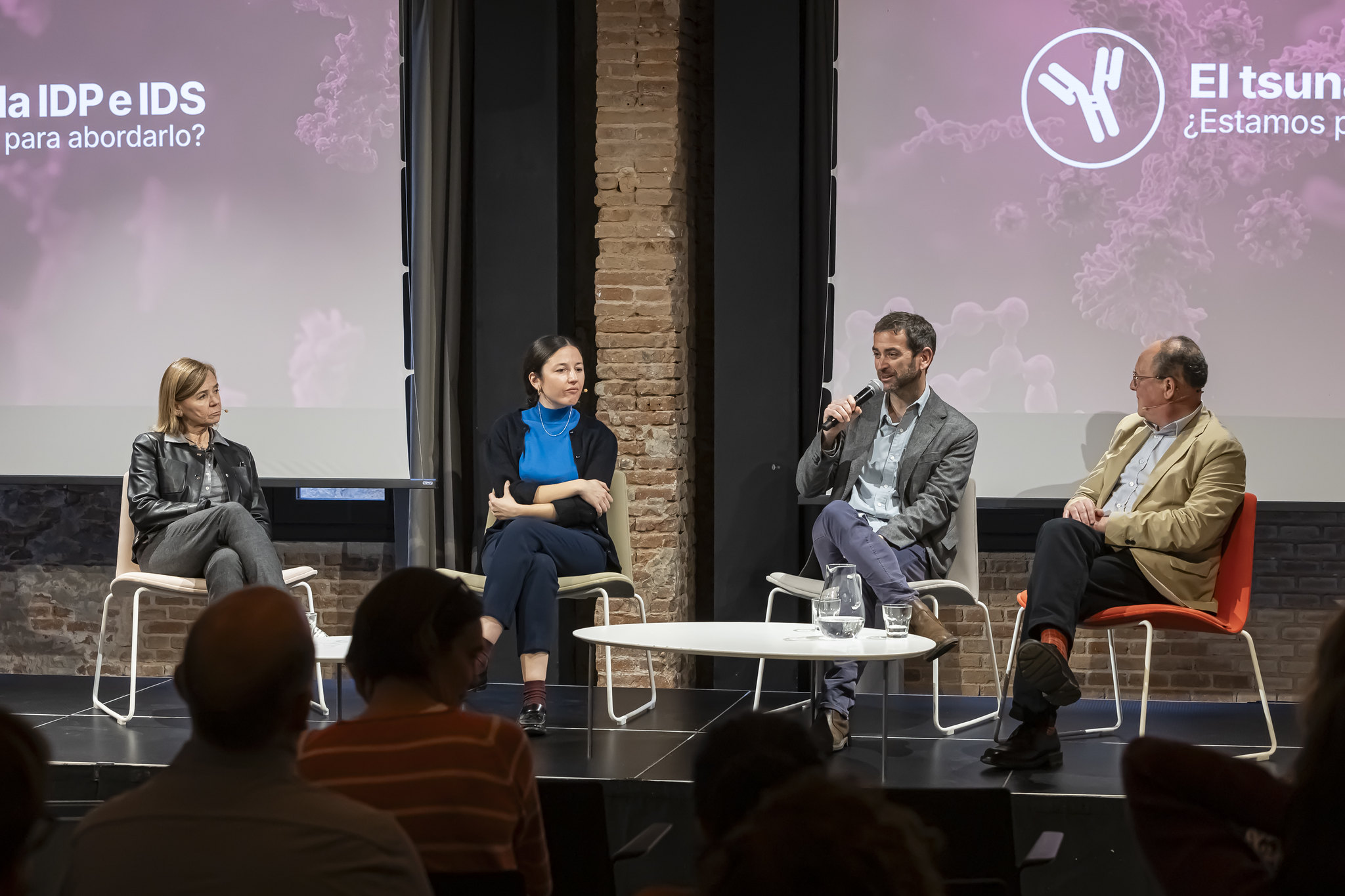
Last March, the Bofill Foundation (HUB Social) hosted the third edition of the scientific conference “The Tsunami of PIDs and SIDs 2026”, organised by ScienHub Education, the platform that drives the training events of the Fight Infections Foundation.
The meeting, now well established as a reference space for healthcare professionals working in the field of primary (PID) and secondary (SID) immunodeficiencies, was coordinated by Dr Lluïsa Pedro‑Botet, Head of the Severe Bacterial Infections research line at the Fight Infections Foundation, and Dr Carme Bracke, researcher at the Foundation.
In addition, Dr Pedro Puerta, Head of the Infections in Immunocompromised People research line, opened the event and guided the scientific meeting throughout the day.
Looking beyond antibody deficiency: the challenge of primary immunodeficiencies
The first block of the conference focused on primary immunodeficiencies, disorders present from birth in which the immune system does not function properly.
In this context, Dr Alba Romero, researcher at the Foundation, highlighted the importance of looking beyond antibody deficiency and adopting a global view of the immune system.
Meanwhile, Dr Pedro Moral, physician at La Fe University and Polytechnic Hospital in Valencia, explored the mechanisms of immune dysregulation and their clinical consequences.
Jacques G. Rivière, paediatric immunologist at Vall d’Hebron University Hospital, provided a comprehensive overview of the therapeutic approach to PIDs, ranging from antibiotic treatment and prophylaxis to bone marrow transplantation, emphasising the role of personalised medicine.
This block underlined the need for early diagnosis and a multidisciplinary approach to improve patients’ prognosis and quality of life.
Secondary immunodeficiencies: a growing clinical “tsunami”
The second part of the day focused on secondary immunodeficiencies, those that can be acquired throughout life. This reality is increasingly present in clinical practice, as the number of oncohaematological patients, individuals with systemic diseases or those undergoing immunosuppressive treatments has risen over the years.
For this reason, Dr Mario Fernández, physician at the 12 de Octubre University Hospital in Madrid, described this growing reality as a true clinical “tsunami”, highlighting the complexity of its management and the need for protocols and care pathways adapted to these new challenges.
Clinical cases to translate knowledge into practice
The event concluded with a block dedicated to clinical cases, one of the most highly valued sections by attendees, which made it possible to translate theoretical content into real-life situations from everyday clinical practice.
Participants included Dr Ana M. Badía, physician at Bellvitge University Hospital (L’Hospitalet de Llobregat), from the field of haematology; Dr Óscar de la Calle, physician at the Hospital de la Santa Creu i Sant Pau in Barcelona, addressing systemic diseases; and Maribel Cuadrado, nurse at the Fight Infections Foundation, who explained the evolution of immunoglobulin replacement therapy.
This session encouraged clinical debate and the exchange of experiences among professionals from different specialties and centres.
A collective acknowledgement
From the Foundation, we would like to sincerely thank all the speakers, attendees and collaborating organisations who made this new edition of the conference possible.
Special thanks go to the sponsors CSL, Pharming Group, Takeda and Grifols for their support and commitment to continuing education and to improving care for people living with immunodeficiencies.
With this third edition, “The Tsunami of PIDs and SIDs” reinforces its role as a key forum for updating knowledge, sharing experiences and moving towards earlier, more effective and more equitable detection and management of these conditions.
Share