


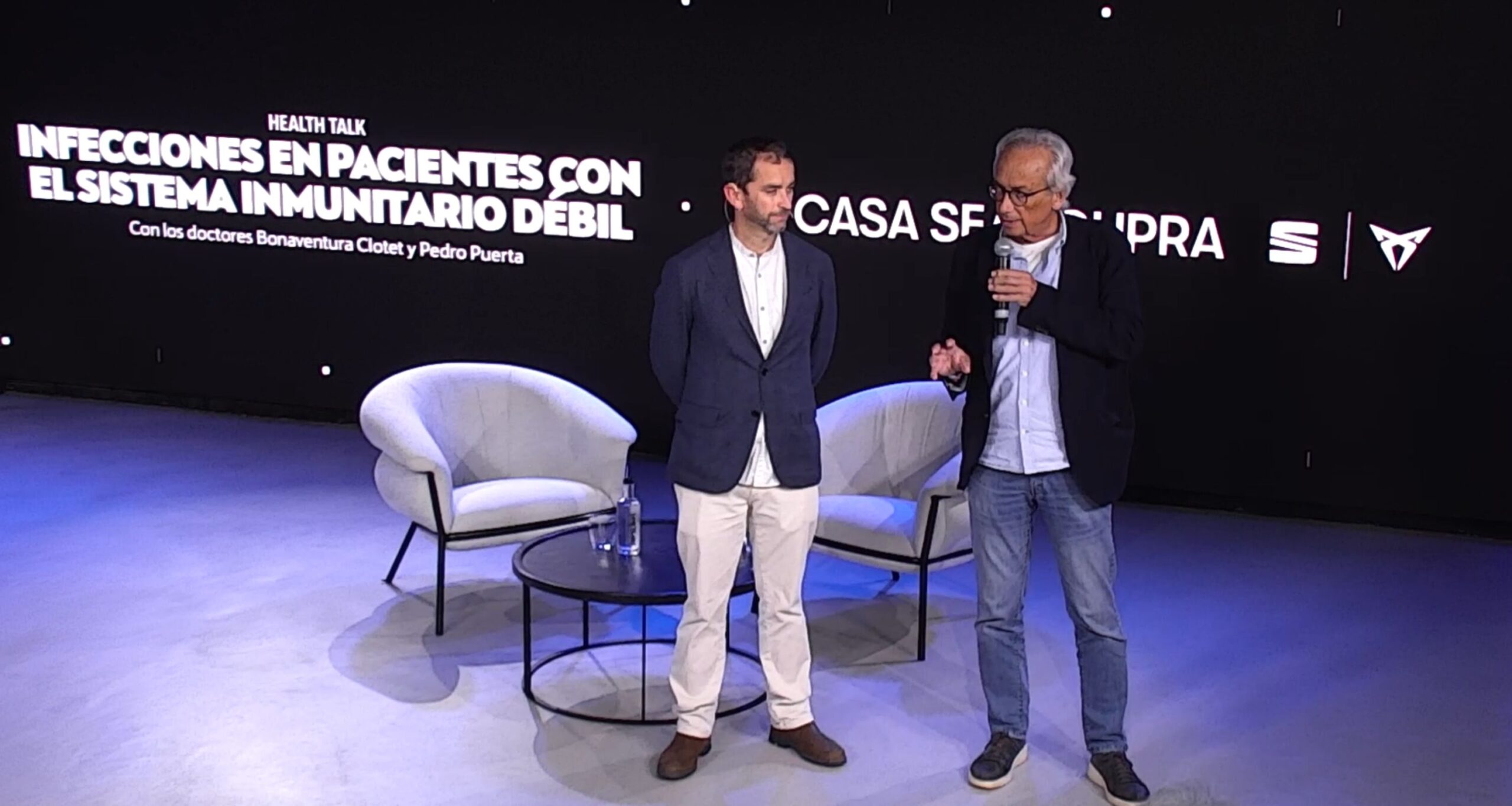
The session was led by Dr. Pedro Puerta, physician and researcher at the Fundació Lluita contra les Infeccions, who highlighted a seemingly paradoxical reality: the same medical advances that allow us to treat diseases and conditions that once had very limited treatment options also mean that more and more people are living with weakened immune systems.
The talk is part of the collaboration between the Fundació Lluita contra les Infeccions and the SEAT CUPRA Foundation, which enables us to bring scientific knowledge closer to the public.
Can you imagine having to live inside a bubble?
We are surrounded by microorganisms. They are in the air we breathe, on our skin, in our food, in our gut and in the people around us. Most cause no problems and many, in fact, are essential to our bodies. However, what happens when our immune defences weaken? A common infection can behave very differently. Some viruses that had remained dormant can reactivate, normally harmless microorganisms can become a threat, and familiar infections such as influenza or COVID-19 may be more likely to cause complications.
Even so, this does not mean that the solution is to live in isolation or “inside a bubble”. On the contrary, the challenge for medicine is to understand each person’s level of risk at any given time so that infections can be prevented, detected and treated more precisely.
What do people, animals and the environment have to do with each other?
Talking about infections also means looking far beyond the hospital. This is where the concept of One Health comes into play: an approach to health that recognises the connection between the health of people, animals and the planet. Microorganisms circulate, evolve and develop resistance within this shared ecosystem.
Infections in immunocompromised people: what if we could anticipate them?
Molecular diagnostics, PCR, immune system monitoring, new treatments and increasingly personalised medicine are changing the way we approach infections in immunocompromised people.
However, the ultimate goal is not for people with weakened immune systems to have to limit their lives to avoid every possible risk. On the contrary, it is about having the knowledge and tools needed to allow people to continue living their lives with the greatest possible quality of life and safety.
Want to know more?
Why can some microorganisms that live alongside us end up causing an infection? What is One Health? Why are antibiotic-resistant bacteria becoming an increasing concern? And how far will we be able to go in anticipating infections? Watch the full talk and discover the answers with Dr. Pedro Puerta.
Share